This is just a quick post to let everyone know that I'll no longer be updating on this blog primarily due to all the spambots that plague this platform. Instead I'll be posting on my ko-fi account—which, in my opinion offers a way better platform for bloggers than blogspot ever has. I realize that it's a site primarily for paying creators, but; if you don't want to pay you don't have to. All of my posts will be open everyone (or they should at least) regardless if they donate or not. Thanks for reading this blog; and I hope you'll continue to read my mad ramblings in the future!
Wednesday, August 25, 2021

Tuesday, November 17, 2020
Legends of the Five Ring Beginner Box Remix
In two days I will run my first game of Legends of the Five Rings rpg, using the beginner box. The adventure within is your standard introductory adventure affair; but, I want to take this opportunity to add to it my own home improvements and my own personal spins.
Scene 1: The Cart and the Peasant
The intention of this scene is to give the PCs someone to talk to in order for them to slide into their characters. With that said, I find it odd that the developers chose an old man that appears nowhere else in the adventure. Instead of an old man and his cart, the PCs come across the following:
As you travel the road, you can hear the sounds of violence coming from around the next bend. Soon after you come upon a scene of two future samurai fending off the attacks of two honorless ronin. Before you can act, the future samurai deliver their finishing blows, sending the ronin running in the direction of Tsuma village.
Pick two of the contestants participating in the Topaz championship to be the future samurai, except for Hitoshi. The future samurai (here on, contestants) will call out to the PCs, asking if they're friend or foe. The contestants are friendly but on edge after their fight.
They claim they met on the road and decided to travel together. They were traveling with an additional contestant (Hitoshi) but they'll claim he parted ways with them after they had an argument. (In fact the contestants were making fun of Hitoshi for being from a Minor Clan and he stormed off in anger.)
As for the ronin, the contestants claim they found them on the road teasing and jeering at a old peasant man who had turned over his cart. After the contestants helped the old man, the ronin continued their insult, but turned their ire towards the contestants. Having enough, the contestants challenged the ronin to a duel, the result of which the PCs witnessed.
The contestants offer to combine their traveling bands and continue the rest of the way to Tsuma village.
Scene 2: Honored Guests.
This scene is when the PCs are first introduced to Hitoshi and make their first checks to (de)escalate his argument with the Innkeeper. This scene is fine as is, but I want to add one additional change. Whether or not Hitoshi has an outburst, Kakita Toshimoko should make an appearance either way.
The head of the dueling academy is here to size up the contestants and throws a layer of contempt on top of his fatherly mentoring when he speaks to Hitoshi. He is indifferent towards the other contestants, except for Kakita Riku whom he harbors high expectations of. He always carries with him an expensive-looking cup filled with high-class sake which an ever-present attendant is always refilling.
Scene 3: Midnight Tea
This scene is fine as is. It presents the dramatic question of the adventure to the PCs. Will the PCs help Hitoshi?
Scene 4: The Competition
Instead of the competition being a mish-mash of physical and mental challenges, the first day is all physical challenges while the second day is all mental challenges. The third day encompasses the dueling tournament.
Day 1: sumai, athletics, horseback riding, weaponry, archery, and hunting
Day 2: heraldry, conduct, poetry, knowledge of Law, and Go
Day 3: The Dueling Tournament
The PCs and contestants are lead out of Tsuma village into the surrounding forest. There they are guided to a clearing where they can see a number of ancient clay pots circling a wooden board. There is a number of clay pots equal to half the number of contestants. On the wooden board is a map of the surrounding forest detailing six other clearings, each labelled with the event being held there.
Here is where the PCs will meet Kitsuki Yuikimi, the current Topaz Champion and Bayushi Sugai, last year's runner-up. Kakita Toshimoko is presiding over the events.
Yuikimi will explain to the contestants that they must navigate the forest to each event, where a judge will be waiting, and will earn points in the form of clay tokens after testing themselves. The first contestants to gain four tokens, navigate back to the clearing, put all eight of their tokens in a pot, and raise their clan's flag will proceed to Day 2. Half of the contestants will be eliminated.
Hitoshi raises his bow into the air saying, "The archery competition is mine!" before dashing in that direction. Hitoshi will proceed to the second day of competition without the PCs involvement. PCs will notice, however, that Crane Clan judges appear to be judging Hitoshi unfairly.
Run the competition normally, allowing PCs to spend bonus successes to gain extra points where they would normally beat the fore-runner. It should take anywhere between 2—4 events for a PC to proceed.
Scene 5: High Spirits
Run as is
---
The rest of the adventure is solid as written. The only change I would make is to the competition on day two. That is allowing PCs to choose their preferred events and earning physical points that they must redeem to proceed to the third day.
Saturday, October 31, 2020
Revisitng Elsai
It's been awhile since I touched base with Elsai, my homebrew setting that I talk about the most on this blog. I really want to revisit Elsai and really think about it; figuring out what lands and what flops, what to keep and what to drop.
I believe the best approach would be to start with some kind of elevator pitch and go about it from the top down.
So here's the pitch:
Elsai is the love child of Conan and Mad Max, born of a romance as described by Terry Pratchett.
That's a lot to unpack. I'm going to start with the ConanxMad Max thing. Elsai is a gonzo setting at its heart. It's a disparate mishmash of several genres; but, sword and sorcery and post-apocalyptic, represented by Conan and Max, are the number 1 and 2 spots on that list.
Elsai is a broken world (the apocalyptic) ruled by cruel liches only concerned with sacrificial gain (the sorcery) where the inhabitants have to fight for their way of life (the sword).
With that said, Elsai seems like a pretty grimdark setting, but that's where Mr. Pratchett comes in. Yes, Elsai is grim and dark; but, it's presented in a humorous and/or satirical light.
An example will explain what that means easier.
Take the lich kings for example. They bill themselves as all-powerful god-kings invulnerable to anyone and anything. Make no mistake, they are powerful, but they are just as lost and confused when it comes to the cosmos as we are. They know next to nothing about the galactic civilization beyond their planet, other than that they use Elsai as a junkyard. They could drop a 200 ton nuclear bomb, annihilating Elsai off the face of the solar system without the liches even knowing. And that fact terrifies them. They talk like Death from Discworld too, IN ALL CAPITAL LETTERS, or an equally silly formatting.
Elsai is a dire world, yes; but, it's also a silly world. Its melting pot of genres make it hard to take seriously, in addition to its weirdness and dialing things to eleven. Also I don't want to drop players into a hopeless meat grinder or beat them over the head with morale lessons more suited for a show like the Walking Dead.
Ok, now that that is out of the way, I'll start by going through the elements one by one and determining if they fit my pitch.
Let's start with the races, the people of Elsai.
I'm not stringent enough to omit any races from a homebrewed setting (except maybe halflings). Chances are if a race exists in D&D, it exists on Elsai. Whether or not it has lore is a different question. Of the races that inhabit Elsai here's a small list and their accompanying lore. (Races will get their own posts later.)
-Humans. Every D&D setting has humans and Elsai is no different. However, I've tried to make them more interesting than just being the default. Humans live in the eight great cities. They're the only race that can learn color magic. They have physical oddities based off what city they're from. For example, humans from Change have subdermal plates on their foreheads, making them look a lot like Klingons.
-Dwarves. The oldest race, dwarves are made from the stone and metal that they work with. They live in factory hiveminds and it's assumed that they were created by the ancient forerunners and built the eight great cities.
-Elves. Being an elf is a curse. They are born of humans infected by the nature plague that originates from the terradomes shattering. Elves are manic, always on the verge of laughing, and over-positive.
-Lizardmen. The ancient colonizers of Elsai now reduced to tribal wanderers. Though some tribes still possess ancient artifacts from their glory days. The race is all male, surviving by asexual reproduction and regeneration.
Those four seem like a good base for now, and they match the usual four races you find in most OSR products.
Moving on to history. Again, this deserves its own post, but I'll summarize briefly here with bullet points:
-A collection of beings inhabited Elsai, creating the dwarves who created the eight great cities. Then they either left or died out. Evidence of their presence only exists in secret chambers accessible only by the lich kings.
-space-faring lizardmen find Elsai and decide to colonize it. They build terradomes to terraform the planet and construct the space station that would become the Broken Ring that encircles Elsai.
-Humans as a civilization are born when the lizardmen's apeman slaves escape confinement and make their way into the eight great cities. The Lizardmen pay them no mind at first because they're brainless monkeys and they're more concerned with elves and the nature plague. The cities have an effect on the humans similar to the monolith from 2001: A Space Odyssey. Humans gain sentience and magic.
-There's a human-lizardman war. This war would lead to the Explocalypse, destroying everything except the eight great cities, leaving countless ruins and destroying the ring space station. Gathox appears in the Red Barren Wastes.
-Elsai is reclassified as a junk planet by the Galactic Civilization and they begin dumping the junk of various subsectors on the planet. Native Elsains scavenge the mountain-sized piles.
That's probably enough to get to the state I want most Elsai campaigns to be in. If any more history comes to mind, it'll get a seperate post.
What else is there? There's culture and tech level, but those are deserving of their own posts, along with specific locations. This post is more about the big picture.
Speaking of big picture, now it's time to get to the real reason I made this post.

I commissioned this map of Elsai from Luka Rejec what feels like forever ago, and I haven't had the chance to use it yet. I gave some rough details and a few key locations and let Luka fill in the rest.
The only thing to say about this map, other than that it's beautiful, is that most of my effort will go towards keying this map when it comes to expanding Elsai.
Monday, October 26, 2020
GLOG Class: Hoplite, a Bronze Age Warrior for Greek Fantasy Games
Starting Equipment: bronze-tipped spear, bronze breastplate, shield, sun-bleached sandals
A: Phalanx Tactics, Pile In
B: Stubborn Sandals, Heroic Advance
C: Shield Brothers, +2 Attack stat
D: Ruthless Cadence
You gain +1 Movement for each Hoplite template you possess
A: Phalanx Tactics
After you make a charge attack, you and allies within 5' gain +1 Defense. If you're equipped with a shield, you and allies within 5' instead gain +2 Defense. A character can only gain this benefit from one Hoplite at a time.
A: Pile In
Once per combat round, after an ally within 20'+Movement is attacked, you can make a free charge attack.
B: Stubborn Sandals
As long as you're wearing sandals, you are immune to effects that knock you prone or knock you back and allies within 5' gain +2 to Save against such effects.
B: Heroic Advance
When you make a charge attack, you can instead call for a heroic advance. When you call for a heroic advance, you and allies within 5' can move 50'+your Movement towards an enemy. Allies have to end their movement within 5' of you.
C: Shield Brothers
When an ally within 5' misses with an attack, they gain +2 to their next attack.
D: Ruthless Cadence
Any hit you score against a creature that has all of their hit points is a critical hit. When you score a critical hit in this way, add your level to the damage dealt.
Shields up, spears out, heels set, hearts firm.

Sunday, October 25, 2020
Boneclaw, the Lich That Gets Hands-On
I put my Eberron campaign on hold until the holidays are over. In the meantime I offered my players a casual, no strings attached, campaign of epic fantasy set in Theros. Last week they encountered their first villain, a boneclaw named Polocho.
Polocho made his debut when his master, his former apprentice, blew up the PCs with a glyph of fireball. While they were tying up the kid, Polocho walked his bone claws out of a window of the adjacent building and grabbed the cleric and wizard. Then he shadow jumped to the building across the street, giving the wizard several new holes. By the time the party reached him, Polocho just dropped the wizard off the building, teleported again, and ran off, daintily picking up his master along the way.
Polocho made his debut when his master, his former apprentice, blew up the PCs with a glyph of fireball. While they were tying up the kid, Polocho walked his bone claws out of a window of the adjacent building and grabbed the cleric and wizard. Then he shadow jumped to the building across the street, giving the wizard several new holes. By the time the party reached him, Polocho just dropped the wizard off the building, teleported again, and ran off, daintily picking up his master along the way.
My players, being the masochists that they are, loved this. Now they are torn between giving a fruitless chase, investigate the burning mage's house, or cheese it since the guards are on the way.
Monday, August 31, 2020
Through the Spyglass
The purpose of this blog has always been a mystery—other than being a depository for my general rpg musings. Awhile ago I had the idea to take this blog in a different direction, but describing that direction with words escaped me until now. I think the best way to explain it would be to unpack the new blog title.
Through the Spyglass. The reference is two-part.
The first part is Lewis Carroll's Through the Looking-Glass.In the sequel to Alice's Adventure in Wonderland we see the titular character return to a fantastical land and experience her most popular adventures. What I want to draw attention to with this new title is how Alice enters this new world. She steps through a mirror; and, the world beyond is like a reflection of the real world. This act of entering a fantasy world by stepping through a mirror is symbolic of sitting down to play rpgs.
In sitting down at the table, getting on discord, or logging in to Roll20 we take that conscientious step into a world that is a fantastical reflection of our own and we embark on adventures that we will remember long after the game has ended.
Another curious thing I want to draw attention to by making this allusion is the mirror. The fantasy worlds we explore through rpgs are reflections of our own world, but mirrors can be two-way. Just as life has many lessons to offer, I believe that rpgs have lessons to offer as well. A part of the new direction I want to take this blog in is exploring those lessons.
The second part is a reference to a classic D&Dism. The spyglass has been in D&D since the early days of 2nd edition and was no doubt added as a joke when players complained about being unable to see distant threats.
I say joke because the spyglass costs 1,000gp and mechanically does nothing. It is, as the 2e phb says, "more of an oddity than a useful item." Perhaps it's a joke or perhaps there's some deeper meaning at play that the designers intended, but the truth of the spyglass' origin eludes me.
Since all D&D blogs must have names with puns, I chose spyglass because it played well with the first reference. But perhaps the spyglass will function as the lens of understanding as I move onward with this blog.
Thursday, July 9, 2020
My First Impressions of Cyberpunk 2020
I finished playing through my first ever module of Cyberpunk2020 tonight.
My edgerunner was a Techie cyborg named Cal Vera who was a member of a nomad clan. I say was because one day they put him down like robocop. But, like robocop, Cal survived and his soul became ever chained to a corporation. Cal was fine with that as long as they kept modding him the fuck out with the cybernetics that he needed to get revenge on his former family.
My companions were a Solo named Wynston and a Nomad named James.
The session started with this koolkat approaching us in the club, telling us someone called his cell asking for us. Whoever was on the other line had perfect English—too perfect. But he had a job for us and we accepted with hesitation.
We asked around the club just in case we were walking into a trap but we learned nothing. Without any leads we headed to the rendezvous, some warehouse down by the docks.
There we met Wilbur, an old edgerunner apparently hired for the same job we were, and there we watched as our mysterious employer revealed himself and a hand cannon that quickly took Wilbur's head off. We shrugged our shoulders and followed our employer. That's life in Night City: you make mistakes; you suffer the consequences.
Our employer took us to the real rendezvous point, a different warehouse, where his boss gave us the details. We were to track down a courier named Wells Fargo and bring him in. That's it. It was a simple tag and bag with a 12,000 eddies payout. We had to say yes.
Our employer gave us what little information they had, a list of this Fargo fella's associates: a corporate agent named Caitlin, some ice junkie named Mistushiko, and an assassin named Lorenzo. We had nothing on the latter two but we had Caitlin's address and we decided to try talking to her.
What followed was a noir-style city crawl as we drove from place to place in Jame's beat up Toyo-Chrysler Omega collecting clues that led to more clues that led to more clues. Eventually we put the picture together.
This Wells Fargo guy—who lost his head in a trash heap of a club in the combat zone—was trying to smuggle some kind of genetic data mule into Night City. The mule was actually a horse—a white stallion to be exact. It also turned out that Mistushiko and Lorenzo were in on it. The former was never a problem, considering she lost her head in a Rock Museum near the Elvis display. Lorenzo though would prove to be one hell of a headache.
All of our sleuthing lead us to the Night City Customs Dock where we saw Lorenzo and company unload the stallion onto a box truck. The truck took off and Lorenzo followed in a sportscar. James realized we were in for a showdown and called in a few favors from his nomad family. What followed was a grueling, exhausting fight on the highway.
No matter what we did our weapons just bounced off of Lorenzo's skinweave as he gunned us down. James and Wynston crashed and burned and Cal never saw them alive again. Afterwards Cal managed to get control of the truck with Lorenzo in hot pursuit. His hold out submachine gun just bounced right off the cyborg assassin and his ripper did jack shit. Lady luck was on Cal's side, however, as he found a hand cannon loaded with armor piercing rounds in the glove-box of the truck. With Lorenzo hanging off the side of the truck, Cal put the barrel to the assassin's head and pulled the trigger. That's when Lorenzo lost his head on the highway.
After clearing the scene and pulling to the side of the road, Cal and the two nomads that survived checked on the goods, but not before gunning down one last goon. The stallion was beat up and injured but he'd live. It was the data that he carried that was valuable anyway.
Heading back to the warehouse, Cal dropped off the horse and took his 12,000 eddies.
6 months later, Cal stood outside some seedy bar in El Paso. He kicked down the door and saw his old family sitting there. "Hey familia! Remember me!" he said as he unfolded his cybernetic arms, revealing two mini-guns, James and Wynston each engraved on their sides. "Mi muchachos would like to have a word with you!" And that's where Cal's story ended—in a blaze of bullets and glory.
-
I want to make one thing clear. This entire scenario was awesome. I had a blast playing a discount terminator with a revenge plot and a death wish and the other players' characters added so much style to the experience. Digging through Night City was amazing as the place is part warzone, part metropolis, and part gated corporate community.
My only gripe about Cyberpunk2020 is that the system for doing all this cool shit is intricate. It really takes awhile to get a grip on all the different intricacies that make the system shine. I would say that Cyberpunk2020 is like D&D 3.5 in that regard. For example, Lorenzo was such a problem for our group because we were noobs that failed to realize the value of armor piercing ammunition. That's why our bullets bounced right off of him. For a less patient new player this could be a big deal breaker. But if you're the kind of player that enjoys a trial by fire and don't mind a sudden and violent end for your choomba, then I can safely say I highly recommend playing Cyberpunk2020.
My edgerunner was a Techie cyborg named Cal Vera who was a member of a nomad clan. I say was because one day they put him down like robocop. But, like robocop, Cal survived and his soul became ever chained to a corporation. Cal was fine with that as long as they kept modding him the fuck out with the cybernetics that he needed to get revenge on his former family.
My companions were a Solo named Wynston and a Nomad named James.
The session started with this koolkat approaching us in the club, telling us someone called his cell asking for us. Whoever was on the other line had perfect English—too perfect. But he had a job for us and we accepted with hesitation.
We asked around the club just in case we were walking into a trap but we learned nothing. Without any leads we headed to the rendezvous, some warehouse down by the docks.
There we met Wilbur, an old edgerunner apparently hired for the same job we were, and there we watched as our mysterious employer revealed himself and a hand cannon that quickly took Wilbur's head off. We shrugged our shoulders and followed our employer. That's life in Night City: you make mistakes; you suffer the consequences.
Our employer took us to the real rendezvous point, a different warehouse, where his boss gave us the details. We were to track down a courier named Wells Fargo and bring him in. That's it. It was a simple tag and bag with a 12,000 eddies payout. We had to say yes.
Our employer gave us what little information they had, a list of this Fargo fella's associates: a corporate agent named Caitlin, some ice junkie named Mistushiko, and an assassin named Lorenzo. We had nothing on the latter two but we had Caitlin's address and we decided to try talking to her.
What followed was a noir-style city crawl as we drove from place to place in Jame's beat up Toyo-Chrysler Omega collecting clues that led to more clues that led to more clues. Eventually we put the picture together.
This Wells Fargo guy—who lost his head in a trash heap of a club in the combat zone—was trying to smuggle some kind of genetic data mule into Night City. The mule was actually a horse—a white stallion to be exact. It also turned out that Mistushiko and Lorenzo were in on it. The former was never a problem, considering she lost her head in a Rock Museum near the Elvis display. Lorenzo though would prove to be one hell of a headache.
All of our sleuthing lead us to the Night City Customs Dock where we saw Lorenzo and company unload the stallion onto a box truck. The truck took off and Lorenzo followed in a sportscar. James realized we were in for a showdown and called in a few favors from his nomad family. What followed was a grueling, exhausting fight on the highway.
No matter what we did our weapons just bounced off of Lorenzo's skinweave as he gunned us down. James and Wynston crashed and burned and Cal never saw them alive again. Afterwards Cal managed to get control of the truck with Lorenzo in hot pursuit. His hold out submachine gun just bounced right off the cyborg assassin and his ripper did jack shit. Lady luck was on Cal's side, however, as he found a hand cannon loaded with armor piercing rounds in the glove-box of the truck. With Lorenzo hanging off the side of the truck, Cal put the barrel to the assassin's head and pulled the trigger. That's when Lorenzo lost his head on the highway.
After clearing the scene and pulling to the side of the road, Cal and the two nomads that survived checked on the goods, but not before gunning down one last goon. The stallion was beat up and injured but he'd live. It was the data that he carried that was valuable anyway.
Heading back to the warehouse, Cal dropped off the horse and took his 12,000 eddies.
6 months later, Cal stood outside some seedy bar in El Paso. He kicked down the door and saw his old family sitting there. "Hey familia! Remember me!" he said as he unfolded his cybernetic arms, revealing two mini-guns, James and Wynston each engraved on their sides. "Mi muchachos would like to have a word with you!" And that's where Cal's story ended—in a blaze of bullets and glory.
-
I want to make one thing clear. This entire scenario was awesome. I had a blast playing a discount terminator with a revenge plot and a death wish and the other players' characters added so much style to the experience. Digging through Night City was amazing as the place is part warzone, part metropolis, and part gated corporate community.
My only gripe about Cyberpunk2020 is that the system for doing all this cool shit is intricate. It really takes awhile to get a grip on all the different intricacies that make the system shine. I would say that Cyberpunk2020 is like D&D 3.5 in that regard. For example, Lorenzo was such a problem for our group because we were noobs that failed to realize the value of armor piercing ammunition. That's why our bullets bounced right off of him. For a less patient new player this could be a big deal breaker. But if you're the kind of player that enjoys a trial by fire and don't mind a sudden and violent end for your choomba, then I can safely say I highly recommend playing Cyberpunk2020.
Friday, May 8, 2020
Night at the Museum
Morgrave University's museum has had the Scroll of Niath, an ancient Xen'drik artifact, on display for the past month. It's been bought by an Aundairian nobleman and is scheduled to ship out of Sharn in a week. The ogre mage Troizig wants the Scroll for Daask and he's recruiting an able, tight-lipped group of adventurers to get it.
 |
| Original map by Dyson Logos |
1. The Communal Privy
Three pedestals stand against the north wall, each holding a Cleansing Stone. When touched the stones repulse dirt and bodily oils, leaving behind the fresh scent of rain. Each pedestal hides a hidden switch. When all three are pressed in the right order, the secret door to the east that leads to room 2 opens. Against the south wall are six small privies. The privies hover open air, the only solid ground being thousands of feet down into the Bowels of Sharn.
2. Perseus' Rest
Beyond the hidden door lies a barren stone room. On the floor is a giant necromantic symbol with a half-rotten human corpse splayed on top of it. Impaling each hand and foot is an iron dagger engraved with silver necromantic runes. This room is the final resting place of Perseus Kingdazer, the former curator of the museum who was sacrificed to become the museum's new security system. Now he haunts the museum at night as a ghost.
Perseus is what gives the exhibits the means to defend themselves. He can possess the exhibits and animate them to defend against would-be thieves—his favorite being the skeleton of the red dragon wyrmling. Below is a list of exhibits that Perseus can possess.
-The skeleton of the red dragon wyrmling, located at 5.
-The wax statues, located at 4.
-The skeleton of the Sword Titan, located at 6.
-The taxidermy Clawfoots, located at 6.
3. Security Desk
This simple wooden desk houses a small weapon rack, spare lanterns, and extra flasks of oil. During the day it is manned by a young human. At night it is manned by an elderly gnome.
4. Eberron Animated
A large pit dominates this exhibit. The pit is recessed five feet into the ground—with safety railings—and the floor is covered with multi-colored rocks. In three different alcoves to the east stands three different wax statues standing on large pedestals. The wax statues are white and featureless until the exhibit is activated.
To the south is a small stone podium with three stone buttons. Each button is engraved with a gnomish rune and a caption in common. The first caption says, "The Giants of Xen'drik;" the second says, "The Treaty of Thronehold;" and the last says, "The Horrors of the Last War." When a button is pressed the wax statues step off their pedestals and morph into historical figures as the multi-colored stones shape into different terrain, both related the topic associated with the pressed button. The statues will enter the pit and act out a small three minute play, re-enacting historical events.
5. The Dragon Skeleton Display
Hidden behind a large glass pane is a small library. Laying on the pedestal next to a bookstand is the skeleton of a red dragon wyrmling set in a sphinx-pose and reading a book. All of the books, except one, are mockups written in gibberish. The real book is a Manual of Flesh Golems misplaced here from the University's library.
6. Dinosaur Exhibit
This room is dominated by the skeleton of a Sword Titan that stands at the center of the room, below a large sunroof. Surrounding it are scenes of taxidermy Clawfoots chasing tribex across the Talenta Plains.
7. The Hall of Twelve Moons
This circular hallway is 30 feet wide and 120 feet long. There are 12 ten-foot long sections of the wall embedded with large glowing glass orbs. The walls rotate in sync with the 12 moons of Eberron. The hallway is trapped but the trap only activates when the pedestal in room 8 is robbed of its contents. Once that happens, the stairs will seal shut and the wall sections will begin to rotate wildly. On initiative count 20 and 10, a random beam with an effect associated with one of the moons will fire at a random creature.
8. The Hidden Vault
In the center of this room is a tall pedestal topped with a glass case. The Scroll of Niath is inside that case. Against the other walls are shelves that can house other treasures. The Scroll is made out of brittle looking papyrus, wrapped around a bronze rod, and inscribed with ancient Elven runes. The scroll functions as a Wand of Polymorph; however, the wielder can spend an extra charge to target an extra creature, or it can spend an extra charge to target an object (as True Polymorph).
Sunday, July 28, 2019
Elsai Overview
Elsai is a small planet and the only inhabited one orbiting its star. From its spaceport—nothing more than a flattened chunk of rock used by stellar scum—Elsai resembles a drop of gasoline on water. At its center is its blue ocean, the Lonely Sea. Circling that is a green whip of fertile land where life clings to existence. Beyond that is the Red Barren Wastes, pockmarked with the junk of the civilizations of Elsai's subsector that call her their dumping grounds.
Circling the Lonely Sea are the Eight Great Cities from where the eight lich kings rule. The Great Cities survived the apocalypse unscathed but none of the minor cities were that lucky.
Elsai was a modern world rife with luxury, innovation, and decadence before its Apocalypse. Afterwards life became a struggle for survival for most. Inhabitants were forced to cave to a life of slavery under the lich king's magitocracy or risk life inside the wastes with raiders and nomads.
The setting invokes the sword and sorcery of Conan, the post-apocalyptic action of Mad Max, and the trappings of pulp sci-fi. In truth it is a galloping gonzo setting where nothing is as serious as it seems.
The lich kings are feared—and for good reason because they are quite powerful. But they are just as lost to the going-ons beyond their planet as anyone else; and, like an apathetic manager who just realized all of their crew suddenly quit, they are trying to salvage the pieces before its too late.
In that regard, I guess you could say Elsai is both a parody and celebration of the genres it siphons inspiration from. But what do I know. I'm just along for the ride.
Circling the Lonely Sea are the Eight Great Cities from where the eight lich kings rule. The Great Cities survived the apocalypse unscathed but none of the minor cities were that lucky.
Elsai was a modern world rife with luxury, innovation, and decadence before its Apocalypse. Afterwards life became a struggle for survival for most. Inhabitants were forced to cave to a life of slavery under the lich king's magitocracy or risk life inside the wastes with raiders and nomads.
The setting invokes the sword and sorcery of Conan, the post-apocalyptic action of Mad Max, and the trappings of pulp sci-fi. In truth it is a galloping gonzo setting where nothing is as serious as it seems.
The lich kings are feared—and for good reason because they are quite powerful. But they are just as lost to the going-ons beyond their planet as anyone else; and, like an apathetic manager who just realized all of their crew suddenly quit, they are trying to salvage the pieces before its too late.
In that regard, I guess you could say Elsai is both a parody and celebration of the genres it siphons inspiration from. But what do I know. I'm just along for the ride.
 |
| by Luka Rejec |
Friday, July 26, 2019
Variant: Secondary Stats
I want ability scores to be king in Variant but secondary stats will be needed to avoid too much interdependence.
Hit Points
I don't want hit points to scale in Variant. Therefore Hit Points will be determined with a simple formula of CON + Class HP, identical to how Dungeon World handles hit points. Ability scores will range anywhere from 1—18 and Class HP will range anywhere from 4—12, meaning a PC's hit points will range anywhere from 5—30.
I use a similar system in my 5e campaign, and in my experience it puts players in a daring but cautious play style—willing to charge into harms way but completely killable.
Armor Class
Known as Defense in most GLOG-likes, Armor Class will be a number ranging from 1—10 and will alter the target number (which is 20 by default) to hit you. The formula is Armor + Dex.
Armor is comprised of light, medium, and heavy; and grant +2, +4, and +6 Armor respectively. Shields are also a thing and grant +1 Armor. A naked PC has 0 Armor.
To write down your armor class, just add 20 to that number. So a full-armored PC with maximum DEX will have an AC of 30.
Inventory
PCs have a number of inventory slots equal to STR. Item weight is tracked by slots. Small items such as jewelry weigh 0 slots, but stacks of small items can add up to multiple inventory slots. Items about the size of a medium weapon such as a longsword, quiver, scroll, and torch weigh 1 slot. Most things bigger than that weigh 2 or more slots.
PCs can carry weight in excess of their inventory slots, but each slot in excess increases the target number for movement-based checks by 1.
Things I'm not including
Attack, Movement, Stealth, and Save will be absent from Variant. These stats always felt like necessities of GLOG's resolution system and I found myself just calling for a simple check instead of calculating the target number.
Hit Points
I don't want hit points to scale in Variant. Therefore Hit Points will be determined with a simple formula of CON + Class HP, identical to how Dungeon World handles hit points. Ability scores will range anywhere from 1—18 and Class HP will range anywhere from 4—12, meaning a PC's hit points will range anywhere from 5—30.
I use a similar system in my 5e campaign, and in my experience it puts players in a daring but cautious play style—willing to charge into harms way but completely killable.
Armor Class
Known as Defense in most GLOG-likes, Armor Class will be a number ranging from 1—10 and will alter the target number (which is 20 by default) to hit you. The formula is Armor + Dex.
Armor is comprised of light, medium, and heavy; and grant +2, +4, and +6 Armor respectively. Shields are also a thing and grant +1 Armor. A naked PC has 0 Armor.
To write down your armor class, just add 20 to that number. So a full-armored PC with maximum DEX will have an AC of 30.
Inventory
PCs have a number of inventory slots equal to STR. Item weight is tracked by slots. Small items such as jewelry weigh 0 slots, but stacks of small items can add up to multiple inventory slots. Items about the size of a medium weapon such as a longsword, quiver, scroll, and torch weigh 1 slot. Most things bigger than that weigh 2 or more slots.
PCs can carry weight in excess of their inventory slots, but each slot in excess increases the target number for movement-based checks by 1.
Things I'm not including
Attack, Movement, Stealth, and Save will be absent from Variant. These stats always felt like necessities of GLOG's resolution system and I found myself just calling for a simple check instead of calculating the target number.
Tuesday, July 23, 2019
Variant: Ability Scores Part II
I've done some Diet Dr. Pepper insomnia fueled thinking and I've decided to ditch the Knave-style resolution system I described earlier.
Instead I've opted for a Target 20-style system. The basic formula is d20 + Score ≥ 20.
The reason I like this system instead is because it gives an average level 1 PC about a 50% chance of success. Plus it's easy for a player to grasp. If they have an average score (10) all they need to roll is double digits to succeed.
Another reason I chose this over Knave's is because I really prefer the Arnold method of rolling 4d4 for ability scores and using the divide-3-minus-3 formula for modifiers.
Also a Target 20-style system establishes that the score is for the d20 and the modifier is for everything else.
Instead I've opted for a Target 20-style system. The basic formula is d20 + Score ≥ 20.
The reason I like this system instead is because it gives an average level 1 PC about a 50% chance of success. Plus it's easy for a player to grasp. If they have an average score (10) all they need to roll is double digits to succeed.
Another reason I chose this over Knave's is because I really prefer the Arnold method of rolling 4d4 for ability scores and using the divide-3-minus-3 formula for modifiers.
Also a Target 20-style system establishes that the score is for the d20 and the modifier is for everything else.
Monday, July 22, 2019
Cars Are Still People
I wrote about vehicle stats awhile ago. While I think it was one of my better posts from that era, I take some issue with it today. So now I'm going to redo them.
Size
Vehicles have a size category ranging from 1 to 4. A vehicle's size determines its seating capacity, storage capacity, its hull points, and its fuel die.
Size
Vehicles have a size category ranging from 1 to 4. A vehicle's size determines its seating capacity, storage capacity, its hull points, and its fuel die.
Ability Scores
Vehicles have the three physical ability scores: Strength, Dexterity, and Constitution. (Vehicles with some kind of artificial intelligence, like KITT from Knight Rider, can have the three mental ability scores.) Generate vehicle ability scores like you would a characters.
Seating and Storage Capacity
The former is the number of normal sized creatures the vehicle can transport; the latter is the amount of stuff a vehicle can transport—represented by slots. It's possible to break both of these capacities; however, breaking one calls for a CON check during travel. On a failure, the axle breaks from the strain and the vehicle is left inoperable. Breaking both capacities gives this CON check disadvantage.
Fuel Die
After 25 miles of driving, roll the vehicle's fuel die. If the result is an odd number, the vehicle uses up a portion of its fuel and the fuel die decreases by a step. A fuel canister can be emptied into a vehicle to increase its fuel die by one step up to its max. A fuel canister takes up two inventory slots.
Hull Points
Vehicles have hull points and 1 hull point is equivalent to 10 hit points of damage. This means that a damage roll has to be 10+ to damage a vehicle. Unlike hit points, hull points do not recover naturally and require repairs. It takes a day of work to repair 1 hull point if materials are available.
Vehicle Armor Class
Small vehicles have less coverage but are fast, while larger vehicles are slow but have more coverage. Therefore a vehicle's size category also determines its AC.
Generating Vehicles
To generate a vehicle on the fly:
1) Roll a d4 to determine its size category.
2) Generate its ability scores.
3) ... and that's it really!
Monday, July 15, 2019
Variant: Ability Scores
Variant is my GLOG hack. I figured I'd start with ability scores.
Arnold started the tradition of generating ability scores using d4s instead of d6s and I'd like to preserve that tradition in Variant. Instead of using GLOG's roll under system, however, I've opted for Knave's roll over system.
Each character rolls 3d4. The lowest result is their modifier and they add 10 to that to get their score .
The math works out to PCs having a +1 or +2 most of the time with a +3 or +4 being rare. Compared to modern 4d6k3, a bonus of +1 is twice as common, a bonus of +2 is 30% more common, and a bonus of +3 and +4 is as common.
The main kind of roll related to abilities is the check. PCs make checks by rolling a d20 and adding their modifier to the roll. If they meet or beat 15, they succeed. If not, they fail. This number changes depending on what the PC is rolling. For example Attacks.
If you're not sure what that number should be, if the PC isn't opposing someone, go with 15. If it's easy, it's a 10. If it's hard, it's a 20. If the PC is opposing someone, go with their number of HD + 10. If that someone is particularly good at whatever the PC is opposed against, add 5 to that number. If they're bad at it, subtract 5.
Negative modifiers will be a thing. Just subtract 10 from the PC's score: an 8 is a -2, for example. A -10 modifier equals death.
Arnold started the tradition of generating ability scores using d4s instead of d6s and I'd like to preserve that tradition in Variant. Instead of using GLOG's roll under system, however, I've opted for Knave's roll over system.
Each character rolls 3d4. The lowest result is their modifier and they add 10 to that to get their score .
The math works out to PCs having a +1 or +2 most of the time with a +3 or +4 being rare. Compared to modern 4d6k3, a bonus of +1 is twice as common, a bonus of +2 is 30% more common, and a bonus of +3 and +4 is as common.
The main kind of roll related to abilities is the check. PCs make checks by rolling a d20 and adding their modifier to the roll. If they meet or beat 15, they succeed. If not, they fail. This number changes depending on what the PC is rolling. For example Attacks.
If you're not sure what that number should be, if the PC isn't opposing someone, go with 15. If it's easy, it's a 10. If it's hard, it's a 20. If the PC is opposing someone, go with their number of HD + 10. If that someone is particularly good at whatever the PC is opposed against, add 5 to that number. If they're bad at it, subtract 5.
Negative modifiers will be a thing. Just subtract 10 from the PC's score: an 8 is a -2, for example. A -10 modifier equals death.
Sunday, July 14, 2019
Mini DM Screen
I made this mini DM screen. It's cheap and easy to make. (Check out Dungeon Craft when you have a chance. Their channel is a treasure trove for OSR and DIY DMs.)


The above screen is for my Elsai setting, which is like a really bad Conan X Mad Max fanfic written by Terry Pratchett. Each image invokes an aspect of the setting. On the left we have Conan, who represents the "Sword" in Sword and Sorcery. Next to him we have an image of the planet itself, desolate and ringed by the dilapidated space station constructed by lizardfolk in ages past. Then we have a war rig, something you'd see in Mad Max. Lastly we have one of the eight tyrannical liches who represent the "Sorcery" in Sword and Sorcery.
Saturday, July 13, 2019
123 Past Present Future
I run a lot of gonzo games. It's not uncommon for a PC in my campaigns to have a longsword in one hand and a machine pistol in the other. This brings the question to mind: How much damage does a longsword do compared to a machine pistol?
The most common answer to this question that I see is none. The level of tech shouldn't matter; just roll a d8 and move on. This answer doesn't really cut it for me. If a swordsman sees his foe whip out a Tommy gun, I want him to start sweating. But this opens a can of worms all on its own.
How much damage should a Tommy gun do? Should we account for sights? Automatic fire? Etc, etc. These questions are the first to come to mind but they lead down a slippery slope. In the long run, it doesn't matter if you perfectly simulate the finer points of firearms.
All that matters is that lasers deal more damage than guns than swords. And to simulate that I've implemented a rule I like to call 123 Past Present Future.
Basically, the weapon in question does 1 die of damage if it's from the past (relative to human history... or not!), 2 dice of damage if it's from the present, and 3 dice of damage if it's from the future.
For example, a longsword would deal a d8. Something like a chainsword would deal 2d8 since it requires levels of tech (machinery, fuel) that is more common in the current era. And a lightsaber would deal 3d8 damage.
The only trick here is finding what's equivalent to what. I would argue that a pistol is the equivalent of a modern day shortbow so it would deal 2d6 damage, but you might think otherwise...and that's OK!
The most common answer to this question that I see is none. The level of tech shouldn't matter; just roll a d8 and move on. This answer doesn't really cut it for me. If a swordsman sees his foe whip out a Tommy gun, I want him to start sweating. But this opens a can of worms all on its own.
How much damage should a Tommy gun do? Should we account for sights? Automatic fire? Etc, etc. These questions are the first to come to mind but they lead down a slippery slope. In the long run, it doesn't matter if you perfectly simulate the finer points of firearms.
All that matters is that lasers deal more damage than guns than swords. And to simulate that I've implemented a rule I like to call 123 Past Present Future.
Basically, the weapon in question does 1 die of damage if it's from the past (relative to human history... or not!), 2 dice of damage if it's from the present, and 3 dice of damage if it's from the future.
For example, a longsword would deal a d8. Something like a chainsword would deal 2d8 since it requires levels of tech (machinery, fuel) that is more common in the current era. And a lightsaber would deal 3d8 damage.
The only trick here is finding what's equivalent to what. I would argue that a pistol is the equivalent of a modern day shortbow so it would deal 2d6 damage, but you might think otherwise...and that's OK!
Sunday, July 7, 2019
The 5e Hack No One Asked for
Player Stuff
Ability Scores
Derivative ability scores are a sacred cow; it's time to take it to the slaughterhouse.
Instead of rolling out ability scores, each character gets the standard array: +3, +2, +2, +1, 0, -1.
Race
I'm tired of my players picking outlandish races for a stat boost and/or power. I want a more grounded grimdark feel. Every character is assumed to be human. If you want to play a member of a certain race, it'll be for roleplay or lore purposes only.
Class
Class features remain unchanged for the most part. When a character receives an Ability Score Improvement, they pick an ability score and improve it by +1, up to a maximum of +5. Spellcasting and Hit Points are also changed (see below).
Proficiencies
I don't need a Survival skill to tell me that the Barbarian might know a thing or two about wild plants. Skill proficiencies are axed. Classes are, instead, proficient with checks related to two ability scores. These are the same as the classes' Saving Throw proficiencies, as written in the book. Weapons, armor, and tool proficiencies remain unchanged.
Proficiency Die
Instead of a static bonus, PCs roll a proficiency die. Just multiply the static bonus by two and slap a "d" behind that number and you'll know which die to roll. If your class has Expertise, roll the die twice and take the better result.
Hit Points
Roll 4d6k3.
You can reroll any results less than your Constitution modifier once.
Add your hit die maximum to the result.
That's your HP for your entire career.
For example. Hrega the Terrible, a barbarian, has a con mod of +3. Her player rolls 1, 2, 4, 6. She rerolls the 1 and 2 and gets 3 and 1. Her result is 13. She adds 12 to that, because Barbarians have a hit die that's a d12, for a total of 25.
Spellcasting
The magic system is Alexandrian (Kempian? It's GLOG's!) in design.
5E has three different spell progression trees for some reason.
Full spellcasters, like wizards, start with 1MD and gain 1MD every level up to a max of 10.
Half-spellcasters, like Rangers and Paladins, get their first MD at level 2 and gain 1MD every second level thereafter up to a max of 5.
One-third spellcasters, like arcane tricksters and eldritch knights, get their first MD at level 3 and gain 1MD every third level thereafter up to a max of 3.
MD stands for Magic Dice. They're d6s.
When the spellcaster casts something, he chooses how many of his MD he wants to invest, then rolls. Dice with results 1—3 go back into the pool and ones with 5—6 are expended till the next rest.
If the spellcaster roll doubles, that's a mishap. If they roll triples, that's a calamity! (I ain't going to write specific mishaps and calamities for each class. That's what an imagination is for. All I need to know is that a mishap is inconvenient and a calamity is, well, cataclysmic.)
the number of [dice] involved as well as the [sum] of those dice determine the outcome of the spell.
Full spellcasters start with 3 spells, half start with 2, and thirds start with 1. They gain a spell every level, every second level, and every third level respectively. Other spells have to be discovered, researched, learned, and/or prayed for.
Clerical magic is more (?) reliable.
(whew! I think that about does it. Why is magic always a complicated affair?)
Background
Ask of your character these questions three: What do they love the most? What do they fear the most? What do they hate the most? These answers three, their background be.
Monster Stuff
Hits
Monsters have hits, instead of hit points. A monster's number of hits is equal to its HD. When a PC hits a monster, the damage roll determines the number of hits lost.
natural 1: 0
2—5: 1
6—9: 2
10+: 4
Other Stuff
Surges
To offset the need for magical healing, each class can do a surge once per combat. A surge is an instant heal that restores Class HD + Level hit points. A first level barbarian would surge for 1d12+1 hit points. A sixth level rogue would surge for d8+6. (A fighter can do this twice with their Second Wind.)
PCs can roll surge for free while resting to restore that many hit points.
Dying
When a PC goes down, they roll their hit die. The result is how many rounds they have left until they bleed out and die, unless they're killed instantly by a hit that deals double their max hit points in damage. Each round the PC has a 5% chance to regain hit die hit points and re-enter the fray.
--
I also wanted to try this thing from Index Card RPG where each area has a set Target Number. If that Goblin Warren has a TN of 14, you'd need to roll that to hit the goblins, disarm their traps, decipher their poo-scribbles, etc. Also allowed for modifers for hard and easy tasks, usually in the for of +/- 3—5.
Ability Scores
Derivative ability scores are a sacred cow; it's time to take it to the slaughterhouse.
Instead of rolling out ability scores, each character gets the standard array: +3, +2, +2, +1, 0, -1.
Race
I'm tired of my players picking outlandish races for a stat boost and/or power. I want a more grounded grimdark feel. Every character is assumed to be human. If you want to play a member of a certain race, it'll be for roleplay or lore purposes only.
Class
Class features remain unchanged for the most part. When a character receives an Ability Score Improvement, they pick an ability score and improve it by +1, up to a maximum of +5. Spellcasting and Hit Points are also changed (see below).
Proficiencies
I don't need a Survival skill to tell me that the Barbarian might know a thing or two about wild plants. Skill proficiencies are axed. Classes are, instead, proficient with checks related to two ability scores. These are the same as the classes' Saving Throw proficiencies, as written in the book. Weapons, armor, and tool proficiencies remain unchanged.
Proficiency Die
Instead of a static bonus, PCs roll a proficiency die. Just multiply the static bonus by two and slap a "d" behind that number and you'll know which die to roll. If your class has Expertise, roll the die twice and take the better result.
Hit Points
Roll 4d6k3.
You can reroll any results less than your Constitution modifier once.
Add your hit die maximum to the result.
That's your HP for your entire career.
For example. Hrega the Terrible, a barbarian, has a con mod of +3. Her player rolls 1, 2, 4, 6. She rerolls the 1 and 2 and gets 3 and 1. Her result is 13. She adds 12 to that, because Barbarians have a hit die that's a d12, for a total of 25.
Spellcasting
Background
Ask of your character these questions three: What do they love the most? What do they fear the most? What do they hate the most? These answers three, their background be.
Monster Stuff
Hits
Monsters have hits, instead of hit points. A monster's number of hits is equal to its HD. When a PC hits a monster, the damage roll determines the number of hits lost.
natural 1: 0
2—5: 1
6—9: 2
10+: 4
Other Stuff
Surges
To offset the need for magical healing, each class can do a surge once per combat. A surge is an instant heal that restores Class HD + Level hit points. A first level barbarian would surge for 1d12+1 hit points. A sixth level rogue would surge for d8+6. (A fighter can do this twice with their Second Wind.)
PCs can roll surge for free while resting to restore that many hit points.
Dying
When a PC goes down, they roll their hit die. The result is how many rounds they have left until they bleed out and die, unless they're killed instantly by a hit that deals double their max hit points in damage. Each round the PC has a 5% chance to regain hit die hit points and re-enter the fray.
--
I also wanted to try this thing from Index Card RPG where each area has a set Target Number. If that Goblin Warren has a TN of 14, you'd need to roll that to hit the goblins, disarm their traps, decipher their poo-scribbles, etc. Also allowed for modifers for hard and easy tasks, usually in the for of +/- 3—5.
Thursday, April 18, 2019
Revisiting the GLOG
It has come to my attention that I am still considered a fixture in the GLOGosphere; which I find somewhat strange since my criticism of GLOG and GLOGers was harsh in the public light, but that's neither here nor there. Anyway I would like to take this opportunity review and revisit the GLOG, and maybe lay some groundwork with what I plan to do with it going forward.
If you don't know GLOG is Arnold K's fantasy heartbreaker homebrew. He designed it on six principles: compatibility with osr modules, a low power level, accessibility for new players, simplicity, quickness of play, and hackablity. It is these principles that have contributed to GLOG becoming so popular in OSR spheres.
Before I continue, let me say that I probably have less than average play time with GLOG. I have yet to run it for a home campaign and the online campaigns where I did were short-lived due to an ever changing work schedule or other interests taking precedent. But I can say with confidence I have at least a weekend's worth of experience running GLOG. Also my version of GLOG was heavily modified from the base, but I don't think that's a surprise to any GLOGers out there.
Roll Under
Let's kick things off with my biggest pet peeve with GLOG. Almost ever roll in GLOG is roll under. You roll under your Strength stat to bust open that door, you roll under your Save to avoid falling rocks, you roll under your Attack (with your opponent's Defense as penalty) to swordify that orc. In general there's nothing wrong with a roll under system, other than all of my players hated it.
I'm not particularly sure why but most of my players could never come to like the roll under system of GLOG. I believe the culprit is human nature. While the OSR prides itself on a return to form, since that form came into being gamers have experienced decades of an ever changing and revised gaming scene. By now "high number good. Low number bad" is ingrained in our gaming brains, and roll under goes against that.
Now I could just tell my players to get over it, but I have found we all had more fun when I switched to a roll over system. In this regard there are several options. Delta's Target 20 is a favorite of mine, but I got more mileage out of adopting the system from Ben Milton's Knave. However the latter felt less OSR than the former.
Class Templates
I both love and hate Templates. While I think it is a neat idea, I have noticed that the abilities they give rarely come up; and they ultimately feel like wasted effort and distraction.
Towards the end I gave up on them entirety and adopted Lungfungus's system in which a class had a passive bonus on up to two stats and two abilities in their kit that they could use from the start. Most of my players like this but sometimes it felt like a class could use one or two more abilities in its kit to properly define its capabilities.
It also goes without saying that the nature of class templates motivates everyone to make their own GLOG classes, which is fine, but I would rather put my focus elsewhere.
Secondary Stats
Stealth and Move are what I call secondary stats. They're secondary to the six ability scores. I believe their purpose is to accommodate common activities. PCs sneak and run a lot and therefore would be better at it (hence the higher base chance) and having a stat as resolution makes things simpler. However a part of me wondered if these could be ditched entirely for simple ability score rolls.
Skills
Skills seem to be the first things to go when someone makes their own GLOG hack and I don't blame them. The system in Arnold's base is kind of clunky. In my GLOG-like I threw out a skill system entirely in exchange for skill tags like Skerples' base. If you're skilled in tailoring you can probably do things a tailor can do.
Weezards
It goes without saying that Arnold's magic system is the greatest contribution from GLOG and, like classes, everyone seems to like to make different wizard schools. Skerples' wizards are a little to mechanically bloated for my tastes and I feel like mishaps and dooms being on a school to school bases is also a little too involved. I'd much prefer a giant mishap/doom table or to get rid of them entirely; I'm fine with wizard's being a walking spell list with 1—3 perks and restrictions.
-
As you can see my negative critique's of GLOG center around its core mechanics, which begs the question, "Why use GLOG at all?" I've heard people ask similar questions of old school hacks of 5th edition: why call it 5th edition when you have had to homebrew it to something else entirely? I'm afraid the only answer I have to that is "I don't know."
At this point GLOG is more than just a system. It's a design philosophy identical to Arnold's original six philosophies when he set out making his fantasy heart breaker. Also it's grown into a community of gamers, aka the GLOGosphere. I think reifying GLOG helps no one and DMs should pursue their and their player's ideal GLOG because at the end of the day all that matters is peeps are having fun rolling weird dice.
-
Moving forward I believe I want to focus my efforts towards putting out my own GLOG-hack. The name for it came to me awhile ago and it's stuck: my GLOG-hack will be called Variant. I would like to put out a full pdf sometime in the future, but at this point "future" is pretty vague because as of right now I'm pursuing other, more personally worthwhile, interests outside of elf games.
I find it helps to lay out some limiting ground rules when first starting a project because it will help direct efforts. When it comes to variant there's only one rule that comes to mind: simple sinister strategy. Now what the heck does that mean? I'll break it down for you.
Simple is simple enough. Everything aspect should be simple: character creation, combat, resolution, etc. If I can't explain it to my players in five minutes or less, if I can't explain it without making them read, then it fails simplicity.
Sinister is more conceptual. The word itself is defined as "giving the impression that something harmful will happen" and I believe that defines a majority of OSR play. Your character is alive, but they will eventually die horribly. The dragon roosts on the mountain, but adventurers will eventually murder it for its hoard. In other words Sinister is a roller coaster ride spiraling towards entropy.
Strategy is the thinking man's sport. I've heard of these DMs that work without rules and just improv every resolution, and that's fine I guess, but I believe it does a huge disservice to players. For players, knowing how a particular event or situation will be handled by a rule is ammunition. If a player doesn't know what ammunition is at his disposal, he won't know what plan best suits his situation; and in my experience I have never met a player who hates it when a plan comes to fruition.
If you don't know GLOG is Arnold K's fantasy heartbreaker homebrew. He designed it on six principles: compatibility with osr modules, a low power level, accessibility for new players, simplicity, quickness of play, and hackablity. It is these principles that have contributed to GLOG becoming so popular in OSR spheres.
Before I continue, let me say that I probably have less than average play time with GLOG. I have yet to run it for a home campaign and the online campaigns where I did were short-lived due to an ever changing work schedule or other interests taking precedent. But I can say with confidence I have at least a weekend's worth of experience running GLOG. Also my version of GLOG was heavily modified from the base, but I don't think that's a surprise to any GLOGers out there.
Roll Under
Let's kick things off with my biggest pet peeve with GLOG. Almost ever roll in GLOG is roll under. You roll under your Strength stat to bust open that door, you roll under your Save to avoid falling rocks, you roll under your Attack (with your opponent's Defense as penalty) to swordify that orc. In general there's nothing wrong with a roll under system, other than all of my players hated it.
I'm not particularly sure why but most of my players could never come to like the roll under system of GLOG. I believe the culprit is human nature. While the OSR prides itself on a return to form, since that form came into being gamers have experienced decades of an ever changing and revised gaming scene. By now "high number good. Low number bad" is ingrained in our gaming brains, and roll under goes against that.
Now I could just tell my players to get over it, but I have found we all had more fun when I switched to a roll over system. In this regard there are several options. Delta's Target 20 is a favorite of mine, but I got more mileage out of adopting the system from Ben Milton's Knave. However the latter felt less OSR than the former.
Class Templates
I both love and hate Templates. While I think it is a neat idea, I have noticed that the abilities they give rarely come up; and they ultimately feel like wasted effort and distraction.
Towards the end I gave up on them entirety and adopted Lungfungus's system in which a class had a passive bonus on up to two stats and two abilities in their kit that they could use from the start. Most of my players like this but sometimes it felt like a class could use one or two more abilities in its kit to properly define its capabilities.
It also goes without saying that the nature of class templates motivates everyone to make their own GLOG classes, which is fine, but I would rather put my focus elsewhere.
Secondary Stats
Stealth and Move are what I call secondary stats. They're secondary to the six ability scores. I believe their purpose is to accommodate common activities. PCs sneak and run a lot and therefore would be better at it (hence the higher base chance) and having a stat as resolution makes things simpler. However a part of me wondered if these could be ditched entirely for simple ability score rolls.
Skills
Skills seem to be the first things to go when someone makes their own GLOG hack and I don't blame them. The system in Arnold's base is kind of clunky. In my GLOG-like I threw out a skill system entirely in exchange for skill tags like Skerples' base. If you're skilled in tailoring you can probably do things a tailor can do.
Weezards
It goes without saying that Arnold's magic system is the greatest contribution from GLOG and, like classes, everyone seems to like to make different wizard schools. Skerples' wizards are a little to mechanically bloated for my tastes and I feel like mishaps and dooms being on a school to school bases is also a little too involved. I'd much prefer a giant mishap/doom table or to get rid of them entirely; I'm fine with wizard's being a walking spell list with 1—3 perks and restrictions.
-
As you can see my negative critique's of GLOG center around its core mechanics, which begs the question, "Why use GLOG at all?" I've heard people ask similar questions of old school hacks of 5th edition: why call it 5th edition when you have had to homebrew it to something else entirely? I'm afraid the only answer I have to that is "I don't know."
At this point GLOG is more than just a system. It's a design philosophy identical to Arnold's original six philosophies when he set out making his fantasy heart breaker. Also it's grown into a community of gamers, aka the GLOGosphere. I think reifying GLOG helps no one and DMs should pursue their and their player's ideal GLOG because at the end of the day all that matters is peeps are having fun rolling weird dice.
-
Moving forward I believe I want to focus my efforts towards putting out my own GLOG-hack. The name for it came to me awhile ago and it's stuck: my GLOG-hack will be called Variant. I would like to put out a full pdf sometime in the future, but at this point "future" is pretty vague because as of right now I'm pursuing other, more personally worthwhile, interests outside of elf games.
I find it helps to lay out some limiting ground rules when first starting a project because it will help direct efforts. When it comes to variant there's only one rule that comes to mind: simple sinister strategy. Now what the heck does that mean? I'll break it down for you.
Simple is simple enough. Everything aspect should be simple: character creation, combat, resolution, etc. If I can't explain it to my players in five minutes or less, if I can't explain it without making them read, then it fails simplicity.
Sinister is more conceptual. The word itself is defined as "giving the impression that something harmful will happen" and I believe that defines a majority of OSR play. Your character is alive, but they will eventually die horribly. The dragon roosts on the mountain, but adventurers will eventually murder it for its hoard. In other words Sinister is a roller coaster ride spiraling towards entropy.
Strategy is the thinking man's sport. I've heard of these DMs that work without rules and just improv every resolution, and that's fine I guess, but I believe it does a huge disservice to players. For players, knowing how a particular event or situation will be handled by a rule is ammunition. If a player doesn't know what ammunition is at his disposal, he won't know what plan best suits his situation; and in my experience I have never met a player who hates it when a plan comes to fruition.
Tuesday, February 26, 2019
The Hunt for Moorcock
I've begun my foray into the works of Michael Moorcock with Elric Melniboné and Other Stories. It's the first of a series of collections that tell Elric's story in chronological order. I'm glad I found it because otherwise I would have had to scrounge up the old books, and a wizard seemingly cast an enlarge spell on their price tags, and my local library keep pulp fantasy at bay with a 10' pole.

Anyway the reason for this post is the dapper gentleman:

Nothing screams epic fantasy to me more than feather plumes and porn staches. Does anyone know who this artist happens to be? I could find no signature or credit.
Wednesday, February 20, 2019
SFW Gun Porn
It's no surprise that nerds fetishize guns. Batman says it best:


Problems crop up when elf games take it too far. Take for example this list from d20 modern:

Keep in mind that's just the handguns.
Now I'm the kind of guy that can never tell the difference between your Beretta 92F and your Beretta 93R, but I do know they both do 2d6 damage. Quick story: I was playing Call of Cthulhu and a friend of a friend asked me why I chose a lower caliber rifle or a higher caliber one. My answer: "They do the same damage."
So if my experience is any indication of the collective elf gamer experience, I should avoid large lists of letter-followed guns with overlapping damage arrays.
The only gun list that's come close to fulfilling my goal is Classic Traveller's:
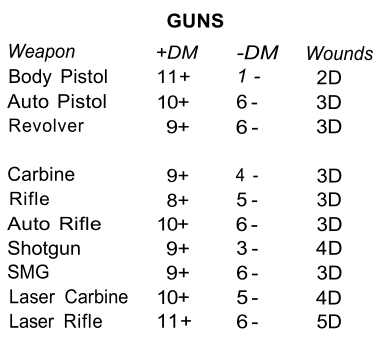
That's all the guns by the way. Such a succinct list; it almost makes me swoon.
This list establishes a few things. It completely ignores model, manufacturer, and caliber, and throws out any notions of "simulation." (Albeit this just makes sense for a sci-fi game set thousands of years in the future. It's still a good rule of thumb.) It has a movie-goers idea of the way damage die progress. As I said I'm no gun expert but I know a laser hurts more than a shotgun hurts more than a rifle hurts more than a pistol.
The only problems with this list is its elaborate matrices that modify attack rolls based off effective range and distance. This is ineffective for a game like Variant that prioritizes simple strategy above anything else. Also damage takes the form of multiple d6s, which in the late 70s was an effective method of generating random numbers but our polygonal overlords have since taken over.
Anyway on to solutions.
Pistols, d6
Your standard pistol. Pistols are the only firearms you can effectively conceal and dual-wield. In the case of dual-wielding, you roll two damage die, taking the better result or adding them together if they are doubles.
Rifles, d8
Rifles are the standard affair when it comes to equipping armies. They are more effective at long range than pistols.
Shotguns, d10
Shotguns are more effective at clearing out groups of opponents but only within close quarters. If you're in a blocks-spanning shootout you're better off using a pistol or rifle. But the tight-corners of a building or dungeon is where shotguns shine.
Lazers, d12
Lazers are the ultimate hurt when it comes to firearms. They are capable of turning adults into minuscule piles of ash.
Explosives, d20
Explosives are a catch-all term for dynamite, grenades, mines, etc. Explosives are deadly against groups of opponents. When an explosive goes off you roll a d20 for everyone caught in the blast radius and deal the better damage to all of them. Most explosives have a blast radius of 20'.
Special Considerations
Group Fire
Firearms that are full-automatic or shotguns can hit additional opponents adjacent to the target. Adjacent opponents save vs Dex or suffer the weapon's damage.
Firing in Melee
Attacking an opponent with a firearm that is adjacent to you imposes disadvantage on your attack roll.
Sights
You can equip a rifle with a sight, which grants advantage on attack rolls from long range.
Subscribe to:
Posts (Atom)